Find the Best Putting Grip to Improve Accuracy, Consistency, and Confidence
A Complete Guide to the Most Popular Putting Grips Used by Tour Professionals
Making more putts isn’t always about buying a new putter.
Sometimes, the biggest improvement comes from something much simpler:
Changing your putting grip.
Your grip directly affects:
- Face control
- Distance control
- Wrist movement
- Consistency
- Confidence
The best putting grip is the one that helps you consistently return the putter face square to the target.
At Golf Gear Authority, we’ve researched the most popular putting grip styles used by PGA Tour professionals and amateur golfers to help you find the grip that fits your stroke.
Why Your Putting Grip Matters
Unlike the full swing, putting requires:
- Precision
- Stability
- Minimal wrist movement
- Excellent face control
A proper grip promotes:
- Better roll
- Improved distance control
- More made putts
- Greater confidence under pressure


Small changes in your grip can produce significant improvements on the greens.
Quick Comparison – Best Putting Grip Styles
| Grip Style | Best For | Wrist Stability | Difficulty | Overall Rating |
|---|---|---|---|---|
| Reverse Overlap | Most Golfers | ⭐⭐⭐⭐ | Easy | ⭐⭐⭐⭐⭐ |
| Cross-Handed (Left-Hand Low) | Better Face Control | ⭐⭐⭐⭐⭐ | Moderate | ⭐⭐⭐⭐⭐ |
| Claw Grip | Eliminating Wrist Action | ⭐⭐⭐⭐⭐ | Moderate | ⭐⭐⭐⭐ |
| Arm Lock | Maximum Stability | ⭐⭐⭐⭐⭐ | Advanced | ⭐⭐⭐⭐ |
| Prayer Grip | Symmetry & Balance | ⭐⭐⭐⭐ | Moderate | ⭐⭐⭐⭐ |
1. Reverse Overlap Grip
Best Overall Putting Grip
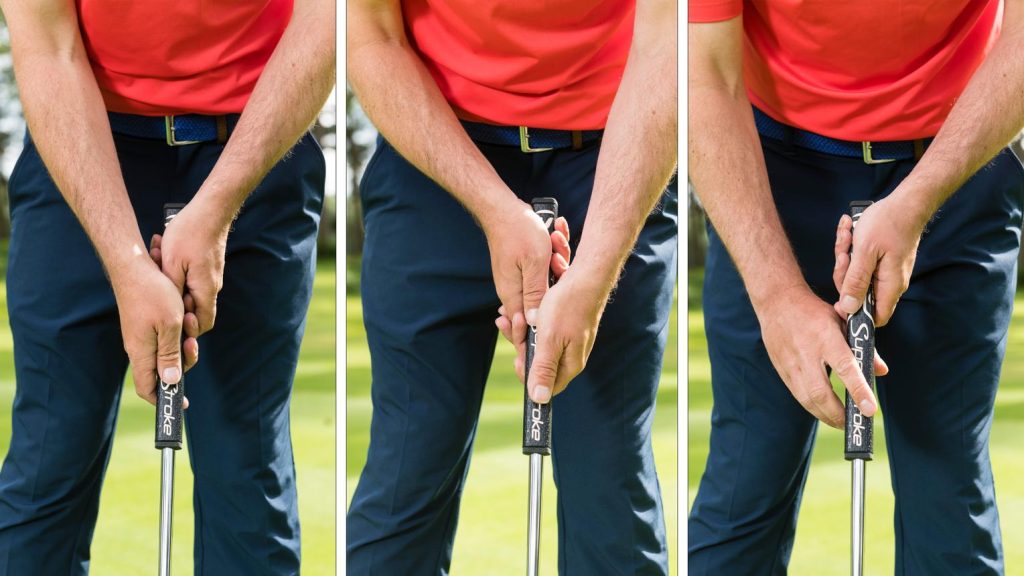
The Reverse Overlap Grip has been the traditional putting grip for decades and remains one of the most popular choices on professional tours.
In this grip:
- Your lead index finger rests over the fingers of your trail hand.
- Both palms work together throughout the stroke.


Advantages
- Easy to learn
- Excellent feel
- Good face control
- Natural stroke
Best For
Golfers of every skill level.
2. Cross-Handed (Left-Hand Low)
Best for Face Control
The Left-Hand Low grip has exploded in popularity on the PGA Tour.
Many golfers switch to this grip after struggling with:
- Pulled putts
- Flipped wrists
- Inconsistent face angle


Advantages
- Reduces wrist breakdown
- Keeps shoulders level
- Improves face stability
- Promotes square impact
Best For
Golfers who struggle with consistency.
3. Claw Grip
Best for Eliminating Wrist Movement
The Claw Grip has become increasingly common among Tour professionals.
Instead of wrapping the trail hand around the grip, the fingers lightly “claw” the side of the putter.


Why It Works
- Minimizes wrist action
- Improves face control
- Reduces yips
- Smooth stroke
Best For
Golfers who struggle under pressure.
4. Arm Lock Grip
Best for Maximum Stability
The Arm Lock technique anchors the grip along the lead forearm (while remaining within the Rules of Golf).
This creates one connected unit between the arms and putter.


Advantages
- Extremely stable
- Excellent face control
- Consistent path
Best For
Golfers seeking maximum consistency.
5. Prayer Grip (Palms Facing)
Best for Symmetry
The Prayer Grip places both palms directly opposite one another.
This encourages both hands to work equally throughout the stroke.


Why Golfers Like It
- Balanced hand position
- Excellent shoulder movement
- Quiet wrists
Best For
Golfers seeking a simple, repeatable stroke.
Which Grip Do PGA Tour Players Use?
While grip preferences vary, many PGA Tour players use:
- Reverse Overlap
- Left-Hand Low
- Claw
- Arm Lock
There is no single “correct” grip.
The best grip is the one that helps you consistently start the ball on your intended line.
How to Choose the Right Putting Grip
Ask yourself:
Do You Pull Putts?
Try:
Left-Hand Low
Do You Flip Your Wrists?
Try:
Claw Grip
Do You Want Maximum Feel?
Try:
Reverse Overlap
Do You Want Maximum Stability?
Try:
Arm Lock
Do You Want Better Symmetry?
Try:
Prayer Grip


Experiment during practice—not during your next tournament.
Improve Your Grip Pressure
Many golfers grip the putter far too tightly.
Think of holding the putter at about 3–4 out of 10 in grip pressure.
A lighter grip:
- Improves feel
- Reduces tension
- Creates smoother tempo
Practice Drill
Use one ball.
Hit:
- Five putts using your current grip.
- Five putts using a different grip.
Notice:
- Face control
- Distance control
- Confidence
Choose the grip that consistently produces the best roll.


Common Putting Grip Mistakes
Gripping Too Tightly
Relax your hands.
Too Much Wrist Action
Let your shoulders control the stroke.
Constantly Switching Grips
Give each grip several practice sessions before deciding.
Ignoring Comfort
Your grip should feel natural and repeatable.
Best Putting Accessories


Best Oversized Grip
SuperStroke Tour 2.0
Best Premium Putter
Scotty Cameron Phantom
Best Technology Putter
Odyssey Ai-One
Best Practice Aid
Putting Mirror
Final Recommendations
Best Overall
Reverse Overlap
Best for Better Face Control
Left-Hand Low
Best for Eliminating Wrist Action
Claw Grip
Best for Stability
Arm Lock
Best for Balance
Prayer Grip
Final Tips
If you’re experimenting with putting grips:
✔ Practice before making permanent changes.
✔ Keep your grip pressure light.
✔ Let your shoulders control the stroke.
✔ Choose the grip that inspires confidence.
✔ Stick with one style long enough to evaluate it properly.
Confidence is just as important as mechanics on the putting green.
Final Verdict
The best putting grip is the one that allows you to consistently return the putter face square at impact while maintaining excellent distance control.
For most golfers, the Reverse Overlap remains the best all-around option because it’s comfortable, easy to learn, and incredibly effective.
Golfers battling wrist movement or inconsistent face control should strongly consider the Left-Hand Low or Claw Grip, both of which have helped countless professionals become elite putters.
Remember, a great putting stroke starts with a grip you trust.