Which Golf Iron Brand Is Better for Your Game?
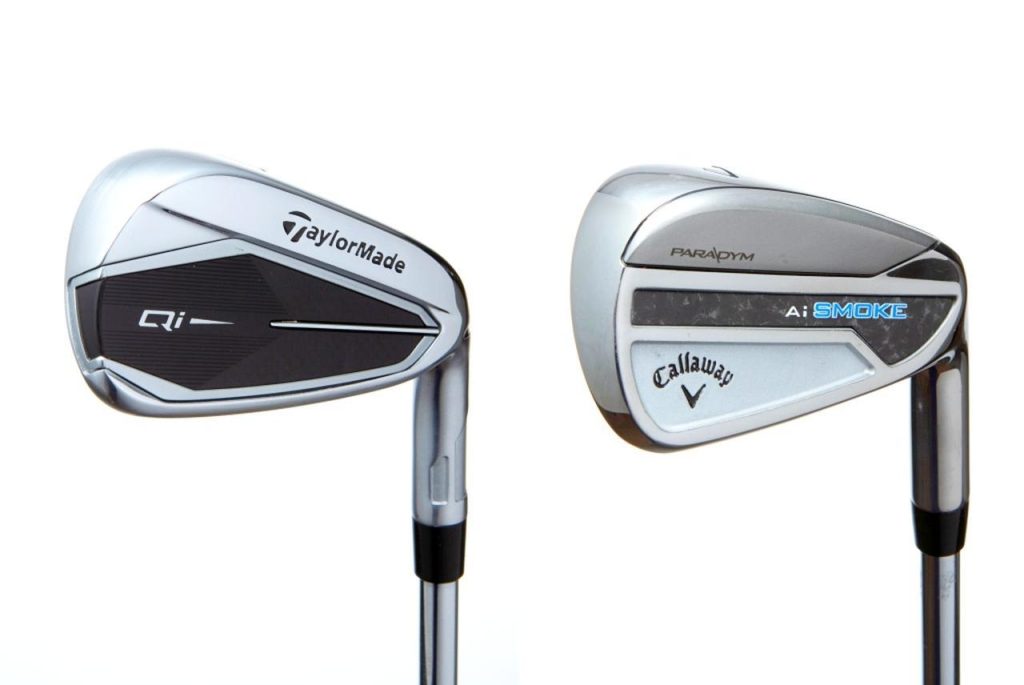
TaylorMade and Callaway produce some of the most popular irons in golf, but choosing between them is not as simple as picking the brand used by your favorite Tour player.
Both companies offer irons for beginners, high handicappers, mid-handicap golfers and accomplished ball-strikers. The important difference is how each brand approaches distance, forgiveness, feel, launch and appearance.
TaylorMade’s current lineup includes the forgiving Qi Max, the popular P790 players-distance iron and more compact P-Series options for skilled golfers. Callaway counters with the Elyte family, the forged Apex Ai200 and the more forgiving Apex Ai300.
This TaylorMade vs. Callaway irons comparison will help you decide which brand—and which specific model—best fits your swing, handicap and goals.


TaylorMade vs. Callaway Irons: Quick Comparison
| Category | TaylorMade | Callaway |
|---|---|---|
| Best game-improvement option | Qi Max | Elyte or Elyte X |
| Best players-distance option | P790 | Apex Ai200 |
| Best premium forgiving forged option | P790 | Apex Ai300 |
| Best for high handicappers | Qi Max or Qi Max HL | Elyte X or Elyte HL |
| Best for low handicappers | P770, P7CB or P7MB | Apex Ai200 and more compact Apex models |
| Typical performance emphasis | Straight distance, speed and progressive launch | Ball-speed consistency, forgiveness and model variety |
| General appearance | Modern and streamlined | Confidence-inspiring with multiple head profiles |
| Overall winner | Depends on the golfer | Depends on the golfer |
There is no universal winner. TaylorMade may appeal more to golfers who value a clean modern look and explosive distance, while Callaway offers an especially broad range of forgiving configurations.
TaylorMade Irons Overview
TaylorMade’s iron lineup covers nearly every type of golfer.
The brand’s 2026 range includes the Qi Max and Qi Max HL in the game-improvement category, along with P-Series options such as the P790, P770, P7CB, P7MB and P7TW.
TaylorMade irons are generally known for:
- Strong ball speed
- Modern head shaping
- Progressive center-of-gravity placement
- Distance on off-center contact
- Multiple players-iron options
- Clean visual designs
TaylorMade Qi Max Irons
The Qi Max is TaylorMade’s main 2026 game-improvement iron.
TaylorMade says it was designed to balance distance and forgiveness with improved sound and feel. The construction includes a sound-stabilization bar, an expanded ECHO Damper and FLTD CG technology that places the center of gravity lower in the long irons to help launch and playability.


What We Like
- High forgiveness
- Strong distance
- Straighter ball flight
- Improved vibration control
- Confidence-inspiring profile
- High-launching long irons
Potential Drawbacks
- Larger appearance than a players iron
- Strong lofts may require careful wedge gapping
- Less workability than compact P-Series irons
Best For
Mid- and high-handicap golfers who want more distance, consistency and protection on mishits.
Click Here to Check Today’s Special Price and Availability
TaylorMade Qi Max HL Irons
The Qi Max HL is the higher-launching version of the standard Qi Max.
It is designed for golfers who need help increasing launch, carry distance and stopping power. It can be a strong option for moderate swing speeds, seniors and golfers who struggle to elevate their long and mid irons.
Best For
- Moderate swing speeds
- Golfers who hit low iron shots
- Seniors
- Players who prioritize carry distance over rollout
Click Here to Check Today’s Special Price and Availability
TaylorMade P790 Irons
The P790 is TaylorMade’s best-known players-distance iron.
Its hollow-body construction is intended to deliver a combination of distance, forged feel, forgiveness and a relatively compact appearance. TaylorMade describes the current P790 as providing a larger sweet spot, improved gapping and consistent distance.


What We Like
- Premium appearance
- Strong ball speed
- More forgiveness than a traditional players iron
- Soft, powerful impact feel
- Clean topline
- Excellent option for a wide handicap range
Potential Drawbacks
- More expensive than many game-improvement sets
- Less forgiving than Qi Max
- Some golfers may need more spin or launch
Best For
Mid-handicap golfers and improving players who want distance and forgiveness in a more compact head.
Click Here to Check Today’s Special Price and Availability
TaylorMade P770 Irons
The P770 is aimed more directly at skilled golfers.
TaylorMade describes it as a compact forged iron with a thin topline, progressive offset, precision-milled faces and grooves, and a design focused on feel, workability and control.


Best For
- Low handicappers
- Consistent ball-strikers
- Golfers who shape shots
- Players who prefer a compact profile
The P770 provides more forgiveness than a traditional blade, but it still demands better contact than the P790 or Qi Max.
Click Here to Check Today’s Special Price and Availability
Callaway Irons Overview
Callaway’s current iron lineup provides a large number of options for golfers who need different combinations of launch, forgiveness, speed and head size.
The Elyte family includes the standard Elyte, Elyte X, Elyte HL and Elyte Max Fast. Callaway also offers forged Apex models such as the Apex Ai200 and Apex Ai300.
Callaway irons are generally known for:
- Strong ball speeds
- Extensive use of face-design technology
- Multiple forgiveness and launch profiles
- Confidence-inspiring shapes
- Excellent options for moderate swing speeds
- Forged Apex choices for improving and advanced golfers
Callaway Elyte Irons
The standard Callaway Elyte is designed for golfers seeking distance, consistency and tight dispersion.
Callaway positions it as a high-forgiveness, high-launch iron for players with average to faster swing speeds. The standard Elyte uses a midsize profile and is intended to offer a more balanced blend of distance and control than the larger Elyte X.


What We Like
- Fast ball speeds
- High forgiveness
- Strong overall distance
- Multiple set and shaft options
- Stable performance across the face
- Suitable for a broad group of golfers
Potential Drawbacks
- Larger than a true players iron
- Stronger lofts can affect wedge spacing
- Some golfers may prefer the softer feel of an Apex model
Best For
Mid- and high-handicap golfers who want distance, launch and consistent performance.
Click Here to Check Today’s Special Price and Availability
Callaway Elyte X Irons
The Elyte X is the more forgiving and confidence-inspiring model in the Elyte family.
Callaway lists it as the option offering maximum forgiveness, the longest distance in the family and a larger profile.
Best For
- High handicappers
- Golfers who miss across the face
- Players who want maximum help getting the ball airborne
- Golfers who prefer a larger clubhead
Click Here to Check Today’s Special Price and Availability
Callaway Elyte HL Irons
The Elyte HL is engineered to produce higher launch, more carry distance and improved stopping power.
Callaway specifically positions the model for players who need help creating a steeper descent angle into the green.


Best For
- Moderate swing speeds
- Seniors
- Golfers who struggle with low launch
- Players who need more carry and stopping power
Click Here to Check Today’s Special Price and Availability
Callaway Apex Ai200 Irons
The Apex Ai200 is Callaway’s players-distance competitor to the TaylorMade P790.
It uses a forged hollow-body design and is intended to combine feel, power and consistency in a more refined profile. Callaway describes it as its most complete players-distance iron.


What We Like
- Premium forged construction
- Clean players-distance appearance
- Strong distance
- More precision than an oversized game-improvement iron
- Good balance of forgiveness and workability
Potential Drawbacks
- Premium price
- Less forgiving than Elyte X
- Better suited to reasonably consistent contact
Best For
Mid- to low-handicap golfers who want speed and forgiveness without moving into an oversized head.
Click Here to Check Today’s Special Price and Availability
Callaway Apex Ai300 Irons
The Apex Ai300 offers more forgiveness than the Ai200 while retaining premium forged construction.
Callaway describes it as a slightly larger cavity-back iron created to blend power, consistency and game-improvement forgiveness.


What We Like
- Forged feel
- More forgiveness than the Ai200
- Strong distance
- Premium construction
- A good bridge between players-distance and game-improvement categories
Potential Drawbacks
- Expensive
- Larger than the Ai200
- Not as workable as a compact players iron
Best For
Mid-handicap golfers who want premium feel but still need meaningful forgiveness.
Click Here to Check Today’s Special Price and Availability
Head-to-Head Model Comparisons
TaylorMade Qi Max vs. Callaway Elyte
This is the most relevant comparison for the average golfer.
| Category | TaylorMade Qi Max | Callaway Elyte |
|---|---|---|
| Forgiveness | Excellent | Excellent |
| Launch | High | High |
| Distance | Long | Long |
| Feel | Dampened and stable | Fast and solid |
| Head size | Game-improvement | Midsize game-improvement |
| Best for | Straight distance and consistency | Speed, dispersion and model flexibility |
TaylorMade emphasizes face flex, straight flight and progressive CG placement in the Qi Max. Callaway emphasizes ball speed, consistency and tight dispersion in the standard Elyte.
Winner: Tie
The better option depends on appearance, sound and your launch-monitor results.


TaylorMade P790 vs. Callaway Apex Ai200
These are two of the leading premium players-distance irons.
| Category | TaylorMade P790 | Callaway Apex Ai200 |
|---|---|---|
| Construction | Hollow-body players-distance | Forged hollow-body players-distance |
| Forgiveness | High for its size | High for its size |
| Look at address | Clean and compact | Refined and compact |
| Distance | Excellent | Excellent |
| Feel | Powerful and soft | Forged and responsive |
| Best for | Broad mid-handicap range | Mid- to low-handicap players |
The P790 may appeal to golfers wanting a little more help and a proven players-distance profile. The Ai200 may appeal to golfers who favor a more forged, precision-oriented presentation.
Winner for Forgiveness: TaylorMade P790
Winner for Traditional Feel: Callaway Apex Ai200
Overall Result: Very Close
TaylorMade P790 vs. Callaway Apex Ai300
The P790 and Apex Ai300 are both premium irons, but the Ai300 has a larger cavity-back profile and a stronger game-improvement focus.
The P790 is generally the better fit for golfers who want a compact players-distance appearance. The Ai300 is the stronger choice for golfers who want premium forged construction with more visible forgiveness.
Winner for Compact Looks: TaylorMade P790
Winner for Forgiveness: Callaway Apex Ai300
TaylorMade Qi Max HL vs. Callaway Elyte HL
Both irons are designed to help golfers launch the ball higher.
The TaylorMade model uses the Qi Max platform with a higher-launch configuration. Callaway’s Elyte HL is built around increased carry and stopping power for golfers who need more elevation.
Winner: Get Fit
This comparison is highly dependent on swing speed, delivered loft, shaft choice and strike location.
Which Brand Is Longer?
Both TaylorMade and Callaway build irons capable of producing significant distance.
TaylorMade often combines flexible faces, strong lofts and low center-of-gravity placement to generate launch and speed. Callaway uses its face-design technology and multiple head configurations to maintain ball speed and dispersion.
However, the iron that travels the farthest during a fitting is not automatically the best iron.
Look at:
- Carry distance
- Spin rate
- Peak height
- Descent angle
- Front-to-back dispersion
- Left-to-right dispersion
- Performance on mishits
An iron that carries five yards shorter but stops more consistently may help you score better.
Which Brand Is More Forgiving?
For maximum forgiveness, compare:
Callaway has a slight advantage in the number of specialized forgiveness profiles available in the Elyte family. Its lineup specifically separates total performance, maximum forgiveness, higher-launch performance and lightweight moderate-swing-speed performance.
TaylorMade’s Qi Max remains a very strong all-around game-improvement option, particularly for golfers who want straight flight and a more streamlined appearance.
Forgiveness Winner: Callaway by a Narrow Margin
Which Brand Feels Better?
Feel is personal and should be tested rather than assumed.
In general:
- TaylorMade Qi Max uses vibration-management technology to improve sound and feel.
- TaylorMade P790 offers a soft, powerful players-distance sensation.
- Callaway Apex Ai200 provides forged feedback in a hollow-body design.
- Callaway Apex Ai300 combines forged construction with a larger, more forgiving cavity-back shape.
Feel Winner for Better Players: Callaway Apex Ai200
Feel Winner for Game-Improvement Golfers: Personal Preference
Which Brand Is Better for High Handicappers?
High-handicap golfers should prioritize:
- Forgiveness
- Launch
- Consistent carry
- Wide sole performance
- Comfortable appearance
- Proper shaft weight
Best TaylorMade Choice
TaylorMade Qi Max
Choose the Qi Max HL when additional launch is needed.
Best Callaway Choice
Callaway Elyte X
Choose the Elyte HL for more launch or Elyte Max Fast for a lighter overall build.
High-Handicap Winner: Callaway
Callaway’s broader selection makes it easier to target specific needs, although the Qi Max may still perform better for an individual golfer.
Which Brand Is Better for Mid Handicappers?
Mid-handicap golfers have several excellent choices.
TaylorMade Options
- Qi Max for maximum forgiveness
- P790 for a more compact players-distance design
Callaway Options
- Standard Elyte for balanced performance
- Apex Ai300 for forged forgiveness
- Apex Ai200 for a more compact players-distance profile
Mid-Handicap Winner: Tie
TaylorMade has a particularly strong one-two combination in the Qi Max and P790. Callaway provides more choices between traditional game-improvement and forged premium categories.
Which Brand Is Better for Low Handicappers?
Low-handicap golfers typically care more about:
- Workability
- Consistent spin
- Turf interaction
- Compact shaping
- Distance control
- Feedback
TaylorMade offers several compact P-Series models, including the P770, P7CB, P7MB and P7TW.
Callaway’s Apex lineup provides players-distance and advanced-player options, with the Apex Ai200 offering a strong blend of compact looks, forged construction and forgiveness.
Low-Handicap Winner: TaylorMade
TaylorMade’s broader P-Series range gives accomplished players more ways to select a specific combination of forgiveness, workability and head shape.
TaylorMade vs. Callaway Irons by Golfer Type
| Golfer Type | Recommended TaylorMade Iron | Recommended Callaway Iron |
|---|---|---|
| Beginner | Qi Max | Elyte X |
| High handicap | Qi Max or Qi Max HL | Elyte X or Elyte HL |
| Mid handicap | Qi Max or P790 | Elyte or Apex Ai300 |
| Improving golfer | P790 | Apex Ai300 |
| Players-distance golfer | P790 | Apex Ai200 |
| Low handicap | P770 or P7CB | Apex Ai200 or compact Apex model |
| Moderate swing speed | Qi Max HL | Elyte HL or Max Fast |
| Golfer wanting forged forgiveness | P790 | Apex Ai300 |
What to Consider Before Buying New Irons
Handicap Is Only a Starting Point
Two golfers with the same handicap may need completely different irons.
One may strike irons well but struggle with putting. Another may need maximum help with contact and launch.
Compare Lofts Carefully
Iron numbers are not standardized across brands.
A 7-iron in one set may have a different loft than a 7-iron in another. Compare loft, carry distance and descent angle rather than assuming the longer club is automatically superior.
Test the Proper Shaft
Shaft weight and profile can influence:
- Launch
- Spin
- Tempo
- Strike location
- Dispersion
- Feel
Check Wedge Gapping
Modern distance irons often have strong lofts.
Make sure the pitching wedge, approach wedge and specialty wedges create manageable distance gaps.
Get Fit Outdoors When Possible
Indoor launch-monitor data is valuable, but observing ball flight and turf interaction can reveal additional differences.
TaylorMade vs. Callaway Irons: Pros and Cons
TaylorMade Irons Pros
- Excellent players-distance options
- Strong P-Series lineup
- Modern shaping
- Impressive distance
- Good blend of speed and forgiveness
- Qi Max offers straight, stable performance
TaylorMade Irons Cons
- Some models carry premium prices
- Fewer specialized game-improvement variations than Callaway
- Compact P-Series irons may be demanding for inconsistent players
Callaway Irons Pros
- Broad model selection
- Excellent forgiveness options
- Strong high-launch choices
- Premium forged Apex models
- Good options for moderate swing speeds
- Multiple head sizes and performance profiles
Callaway Irons Cons
- The number of models can make choosing confusing
- Some premium Apex sets are expensive
- Larger models may not appeal to golfers who prefer compact heads
Final Verdict: Are TaylorMade or Callaway Irons Better?
TaylorMade and Callaway both make excellent irons, but each brand has particular strengths.
Choose TaylorMade If:
- You want a modern, streamlined design.
- You prefer the P790 players-distance profile.
- You are a skilled golfer interested in several compact P-Series options.
- You want a strong all-around game-improvement iron in the Qi Max.
- Straight distance and clean shaping are priorities.
Choose Callaway If:
- You want the widest selection of forgiveness and launch profiles.
- You need maximum help from an oversized game-improvement iron.
- You prefer forged Apex feel.
- You have a moderate swing speed and want a purpose-built lightweight or high-launch model.
- You want to choose between several head sizes within the same family.
Best for High Handicappers
Callaway Elyte X
Best for Mid Handicappers
TaylorMade P790 or Callaway Apex Ai300
Best Players-Distance Iron
TaylorMade P790 and Callaway Apex Ai200
Best for Low Handicappers
TaylorMade P770 or P7CB
Best Overall Game-Improvement Iron
TaylorMade Qi Max
The most important conclusion is simple: do not buy based on brand name alone. Test comparable models using the same golf ball and evaluate carry, spin, height, descent angle and dispersion.