The Best Players Irons for Feel, Control, Workability, and Precision
Low-handicap golfers need something different from their irons.
Maximum forgiveness and raw distance are rarely the only priorities. Better ball strikers typically want predictable carry distances, trajectory control, consistent spin, precise turf interaction, premium feel, and the ability to shape shots when necessary.
The good news is that modern players irons no longer force you to choose between precision and all forgiveness. Today’s best designs use tungsten weighting, refined cavity structures, forged construction, and carefully engineered center-of-gravity locations to provide more stability while maintaining the compact profiles accomplished golfers prefer.
At Golf Gear Authority, we’ve selected five of the best irons for low handicappers in 2026 from Titleist, PING, TaylorMade, Mizuno, and Srixon.


Best Irons for Low Handicappers at a Glance
| Iron | Best For | Category | Standout Feature | GGA Rating |
|---|---|---|---|---|
| Titleist T100 | Best Overall | Players Cavity | Precision and control | 5/5 |
| PING i240 | Best Forgiveness | Players Iron | Forgiveness + consistency | 4.9/5 |
| TaylorMade P7CB | Best for Ball Strikers | Players Cavity | Forged feel + workability | 4.9/5 |
| Mizuno Pro S-3 | Best Feel | Players Cavity | Grain Flow Forged feel | 4.9/5 |
| Srixon ZXi7 | Best Turf Interaction | Players Cavity | Tour V.T. Sole | 4.8/5 |
Best Overall Irons for Low Handicappers
Titleist T100 Irons
The Titleist T100 is our best overall iron for low-handicap golfers because it delivers nearly everything accomplished players should be looking for: precise distance control, premium feel, compact shaping, trajectory control, and enough stability to prevent every slight miss from becoming a major penalty.
Titleist describes the current T100 as its Modern Tour Iron, designed specifically for players who value precise shotmaking and control. The fully forged construction combines a thin topline and minimal offset with high-density tungsten and a progressive dual-cavity structure.


Why We Like It
- Fully forged construction
- Compact Tour-inspired shape
- Thin topline
- Minimal offset
- Excellent distance control
- Split high-density tungsten
- Progressive dual-cavity construction
- Improved Variable Bounce Sole
- Excellent trajectory control
- More forgiveness than a traditional muscle-back blade
Best For
Low-handicap and competitive golfers who prioritize precision, feel, consistency, and complete control over maximum distance.
Golf Gear Authority Take
The T100 represents what we think a modern low-handicap iron should be.
It still looks like a serious players club at address, but Titleist hasn’t ignored what happens when you miss the center by half an inch.
The combination of tungsten weighting and Variable Face Thickness adds useful stability without turning the T100 into an oversized game-improvement iron. Titleist also redesigned the 3- and 4-irons with a lower-CG muscle channel to improve launch and carry consistency in the clubs that are hardest to hit.
The mid- and short-irons receive more aggressive grooves to help maintain spin control from rough and wet conditions.
That complete-set approach is important.
Low handicappers don’t simply need a 7-iron that produces impressive launch-monitor numbers. They need predictable performance from the long irons through the scoring clubs.
For 2026, the Titleist T100 is our best overall iron for low handicappers.
Most Forgiving Irons for Low Handicappers
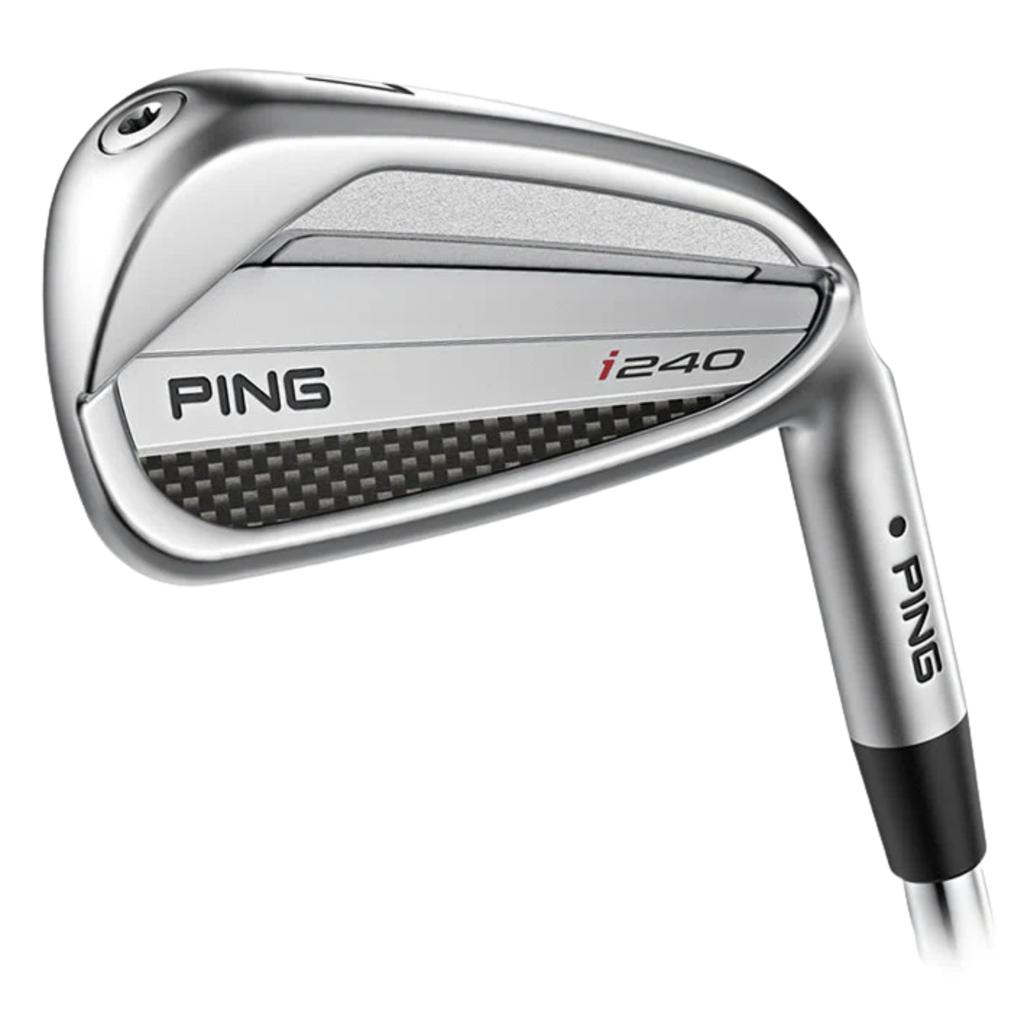
PING i240 Irons
Not every low-handicap golfer wants to play the smallest iron possible.
The PING i240 is our choice for golfers who want the appearance, control, and feel of a players iron with a little more protection when contact isn’t perfect.
PING specifically designed the i240 to add forgiveness while maintaining a Tour-inspired appearance. A lower center of gravity helps produce higher launch, while weight saved from the badge and insert is redistributed around the perimeter to increase MOI—particularly in the long and mid irons.


Why We Like It
- Tour-inspired appearance
- More forgiving than many players irons
- Higher-launching design
- Increased perimeter weighting
- Excellent long-iron stability
- Precise distance control
- Consistent spin
- Clean appearance at address
- Multiple loft configurations
- Excellent custom-fitting options
Best For
Low handicappers who want players-iron control without giving up unnecessary forgiveness.
Golf Gear Authority Take
There’s no extra credit on the scorecard for making golf harder.
That’s why the i240 makes so much sense.
PING has managed to build additional stability into a head that still looks appropriate behind the ball for a skilled player.
The additional MOI is particularly valuable in the long and mid irons, where even low handicappers don’t find the center every time. PING also offers standard, Power Spec, and Retro Spec loft configurations, creating more fitting opportunities for golfers trying to dial in launch and distance gaps.
Golf Monthly’s 2026 PING iron guide specifically recommends the i240 for low handicappers, highlighting its feel, workability, and spin consistency.
If you’re a 3- to 8-handicap golfer who likes the appearance of a players iron but doesn’t want blade-level punishment, the PING i240 should be high on your fitting list.
Best Irons for Pure Ball Strikers
TaylorMade P7CB Irons
For golfers who consistently find the middle of the face and want more feedback and control, the TaylorMade P7CB is one of our favorite choices.
The P7CB combines a compact players shape with forged construction and strategically positioned mass to create the type of controlled performance better ball strikers tend to prefer.


Why We Like It
- Compact blade length
- Thin topline
- Minimal offset
- Forged 1025 carbon steel
- Precise launch and spin
- Excellent workability
- Premium impact feel
- Progressive sole design
- Perimeter weighting adds stability
- Excellent traditional appearance
Best For
Low-handicap golfers and accomplished ball strikers who prioritize feedback, shot shaping, trajectory control, and precise distance over maximum forgiveness.
Golf Gear Authority Take
The P7CB sits in a very appealing position between a muscle-back blade and a more forgiving players cavity.
That’s exactly where many low-handicap golfers should be looking.
You still get the compact profile and clean appearance that make it easy to visualize different trajectories, but there’s enough perimeter weighting to provide more stability than you’d expect from a traditional blade.
The P7CB’s forged 1025 carbon-steel construction, milled face and grooves, compact blade length, and progressive sole are all aimed at producing consistent launch, spin, and turf interaction.
This isn’t the iron we’d recommend to someone who needs help generating distance.
But if your iron game is already one of the strengths of your game and you’re looking for precision rather than assistance, the P7CB is an excellent choice.
Best Feeling Irons for Low Handicappers
Mizuno Pro S-3 Irons
Feel is subjective, but Mizuno continues to be one of the first brands accomplished golfers consider when soft forged feel is a priority.
The Mizuno Pro S-3 combines a compact cavity-back profile with Mizuno’s Grain Flow Forged HD construction and 1025E Pure Select Mild Carbon Steel.
A copper underlay is used beneath the finish to further influence vibration and impact sensation.


Why We Like It
- Grain Flow Forged HD construction
- 1025E Pure Select Mild Carbon Steel
- Copper underlay
- Premium impact feel
- Compact players shape
- Thin topline
- Minimal visual bulk
- Triple Cut Sole
- Excellent turf interaction
- Beautiful traditional appearance
Best For
Golfers who put premium forged feel and feedback near the top of their iron-buying priorities.
Golf Gear Authority Take
There’s a reason accomplished golfers talk about Mizuno iron feel.
A low handicapper usually doesn’t need the clubhead to hide every mistake.
In fact, feedback can be useful.
Knowing immediately whether contact was slightly thin, toward the toe, or perfectly centered helps good players understand what’s happening with their swing.
The S-3’s combination of mild carbon steel, Grain Flow Forging, and copper underlay is designed around that type of impact experience, while the Triple Cut Sole provides versatile turf interaction.
It also looks exactly like we’d expect a premium players iron to look—compact, clean, and free of unnecessary visual distractions.
If feel is the deciding factor, the Mizuno Pro S-3 deserves to be hit before you make a final decision.
Best Irons for Turf Interaction
Srixon ZXi7 Irons
The Srixon ZXi7 is an excellent option for accomplished golfers who pay close attention to how an iron moves through the ground.
Srixon’s Tour V.T. Sole combines leading-edge bounce with trailing-edge relief to help the club move efficiently through the turf instead of digging excessively.
The ZXi7 also uses a single-piece forged construction, S15C steel, tungsten weighting, and Srixon’s PureFrame design behind the impact area.


Why We Like It
- Single-piece forged construction
- Soft S15C steel
- Tour V.T. Sole
- Excellent turf interaction
- PureFrame construction
- Tungsten weighting
- Compact players profile
- Thin topline
- Minimal offset
- Progressive groove design
- Excellent workability
Best For
Low-handicap golfers who prioritize turf interaction, workability, control, and a traditional forged feel.
Golf Gear Authority Take
Turf interaction can be overlooked when golfers shop for irons using only launch-monitor numbers.
But better players notice it immediately.
The way the leading edge enters the ground and the sole exits the turf can influence strike consistency, particularly for players who take a meaningful divot.
That’s where Srixon’s Tour V.T. Sole has developed such a strong following.
The ZXi7 pairs that sole geometry with the compact shape, narrow sole, thin topline, and minimal offset we’d expect from a true players iron.
Srixon also uses different groove designs through the set to help optimize performance from long irons through scoring clubs.
If you’re a low handicapper with a steeper delivery or simply someone who is extremely particular about turf interaction, the ZXi7 needs to be on your shortlist.
What Should a Low Handicapper Look for in Irons?
Distance Control Over Maximum Distance
This may be the biggest difference between shopping for players irons and game-improvement irons.
A low handicapper generally shouldn’t care whether one 7-iron travels 175 yards while another travels 168.
What matters is whether it travels the expected distance consistently.

For an accomplished golfer, predictable carry distances make it easier to:
- Attack tucked pins
- Carry hazards
- Control trajectory
- Manage front and back numbers
- Choose clubs confidently
That’s one reason the Titleist T100 sits at the top of our list. Its design prioritizes consistency and precise trajectory control rather than simply producing the highest possible ball speed.
Forgiveness Still Matters
Playing to a 3 handicap doesn’t mean you hit every iron from the center.
The difference is that you probably don’t need the same amount of help as a 20-handicap golfer.
Modern players irons can provide useful stability without looking like game-improvement clubs.
The PING i240 is a perfect example.
PING redistributed weight to the perimeter specifically to increase MOI while preserving the control and appearance expected from a players-style iron.
There’s no reason to reject forgiveness simply because you’re a good player.
Players Cavity vs. Muscle-Back Blade
Low handicappers sometimes assume they’re supposed to play blades.
They’re not.
Players Cavity Irons
Provide:
- More stability
- Slightly larger effective hitting areas
- Better long-iron forgiveness
- Excellent feel
- Plenty of workability
Muscle-Back Blades
Provide:
- Maximum feedback
- Compact shaping
- Excellent trajectory control
- Minimal assistance on mishits


For most low handicappers, we think a players cavity is the smarter choice.
Even many elite competitive golfers use cavity-backed irons or blended sets.
Should Low Handicappers Use Combo Iron Sets?
Absolutely.
In fact, this may be one of the best ways to build an iron set.
A golfer could use:
4-5 Iron: More forgiving players-distance model
6-7 Iron: Players cavity
8-PW: Compact players iron or blade
Titleist specifically designs its current T-Series irons so models can blend together within the same set.


This gives you more launch and forgiveness where you need it while retaining maximum control in the scoring clubs.
Don’t Choose Irons Based Only on Handicap
A 2-handicap with moderate speed and a shallow delivery may need a completely different iron from a 7-handicap with high speed and a steep attack angle.
Consider:
- Clubhead speed
- Typical miss
- Launch
- Spin
- Peak height
- Angle of descent
- Turf interaction
- Preferred head shape
- Shaft weight
- Carry-distance gaps
Handicap is a useful starting point.
It isn’t a fitting specification.
Should Low Handicappers Get Fit for Irons?
Yes.
If you’re skilled enough to benefit from a players iron, you’re skilled enough to benefit from a proper fitting.


Pay particular attention to:
- Shaft model
- Shaft weight
- Flex
- Lie angle
- Length
- Loft configuration
- Launch
- Spin
- Descent angle
- Carry-distance gaps
Small differences matter more when you’re trying to hit a specific number rather than simply advance the ball toward the green.
Best Irons for Low Handicappers by Category
Best Overall: Titleist T100
Most Forgiving: PING i240
Best for Ball Strikers: TaylorMade P7CB
Best Feel: Mizuno Pro S-3
Best Turf Interaction: Srixon ZXi7
Final Verdict
Our best irons for low handicappers in 2026 are the Titleist T100.
The T100 delivers the compact appearance, forged feel, trajectory control, and precision accomplished golfers expect while incorporating enough modern technology to provide useful stability when contact isn’t perfect. Titleist itself identifies the T100 as ideal for low-handicap and competitive golfers who prioritize precise shotmaking, feel, and control.
If you want additional forgiveness, we’d strongly consider the PING i240. It may provide one of the best combinations of players-iron appearance and useful stability in this category.
Pure ball strikers should put the TaylorMade P7CB on their testing list, while golfers obsessed with forged feel should spend some time with the Mizuno Pro S-3.
And if turf interaction is one of your biggest priorities, the Srixon ZXi7 and its Tour V.T. Sole are difficult to overlook.
The key is not choosing the smallest iron you can hit.
Choose the iron that gives you the precision you want while providing the amount of forgiveness you actually need.